
OPTI-6G
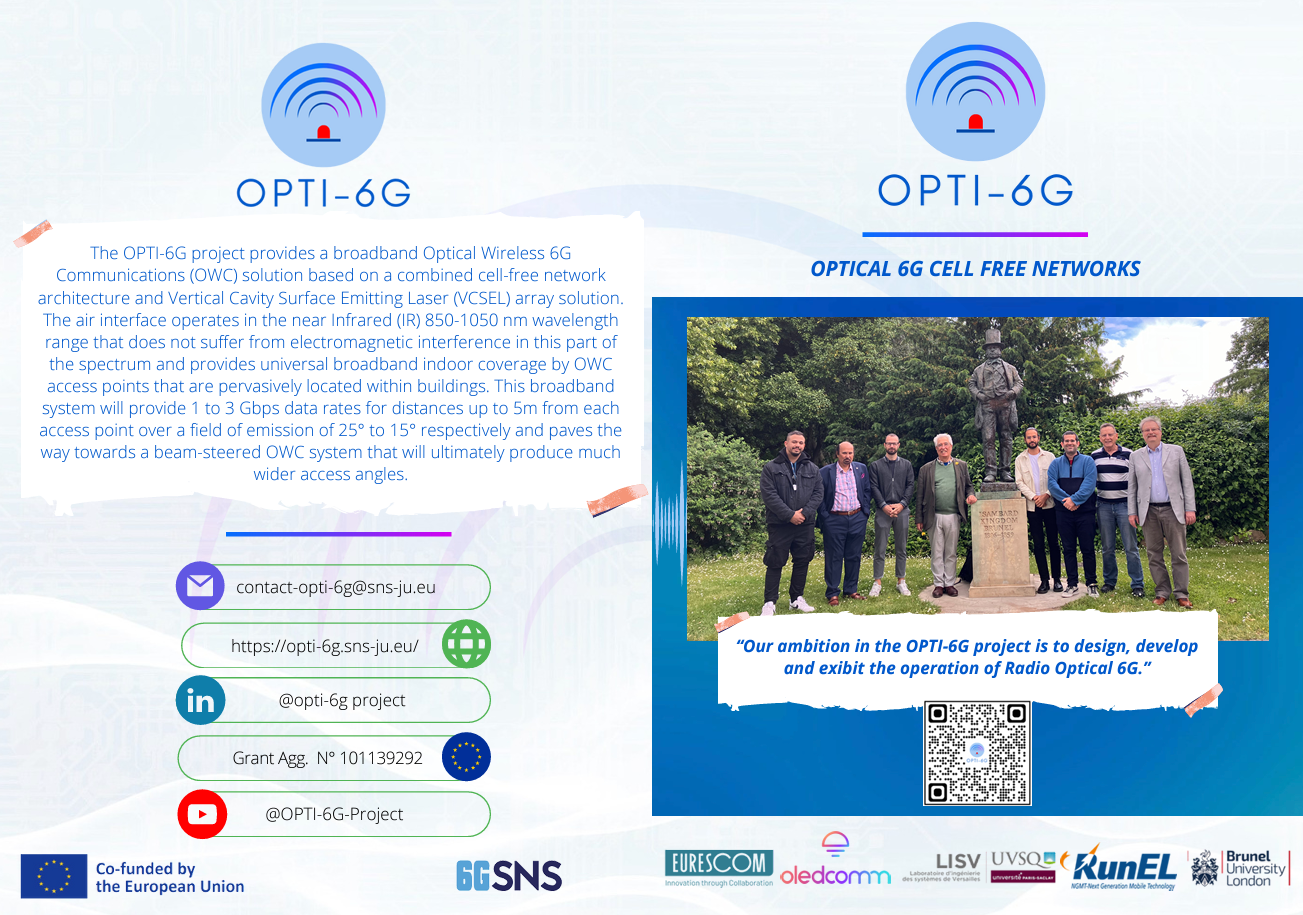
Our ambition in the OPTI-6G project is to design, develop and exibit the operation of Radio Optical 6G.
Learn moreOPTICAL 6G CELL FREE NETWORKS

OPTI-6G Final Project Event
Join us to discover optical wireless 6G technologies in action & experience live demos of a novel cell-free radio-optical system shaping the future of indoor connectivity.
Register now for free!
OPTI-6G FLYER
This research project is to integrate cell-free sub-THz and near IR 6G network architectures.
Download the flyer here


OPTI-6G Final Event in Brunel University London
The OPTI-6G Final Event marks the conclusion of the OPTI-6G project, running from January 2024 to December 2026 under the Horizon Europe framework and the Smart Networks and Services Joint Undertaking. This event brings together researchers, industry representatives, and innovators to present the project’s key outcomes and demonstrate how optical wireless technologies can shape future 6G networks.
At its core, OPTI-6G has developed a novel radio-optical 6G system designed for seamless deployment in homes, businesses, and public buildings. By combining cell-free sub-THz and near-infrared technologies, the project introduces a new way to deliver high-speed, interference-free connectivity while enabling advanced localisation and sensing capabilities.
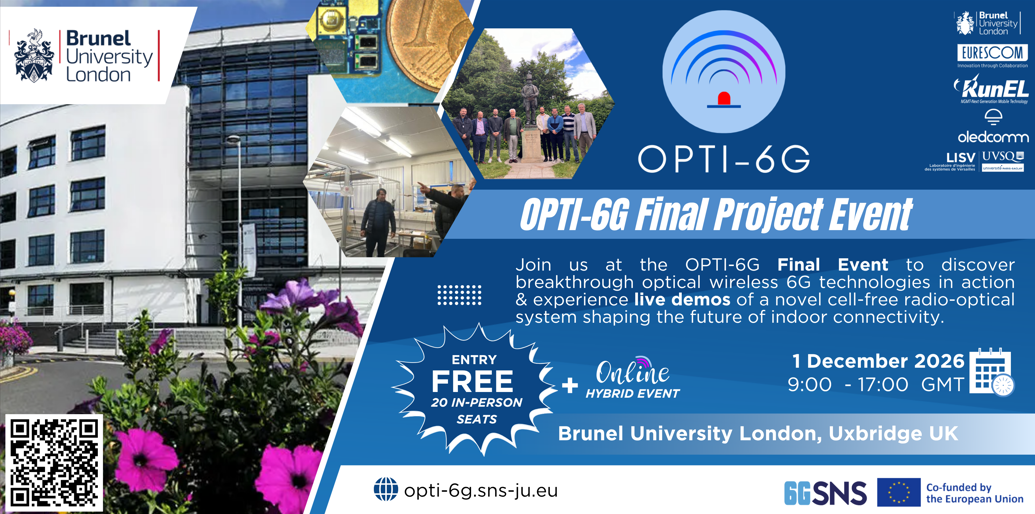
Date & Time: 1 December 2026, 09:00–17:00 (GMT)
Location: Brunel University London, HWLL 139
Format: Hybrid event – limited in-person capacity (20+ participants)
OPTI-6G Project to Lead Optics and Photonics Innovations Workshop at EuCNC & 6G Summit 2025
OPTI-6G at EuCNC & 6G Summit 2025 Workshop on Integrated Sensing and Communications
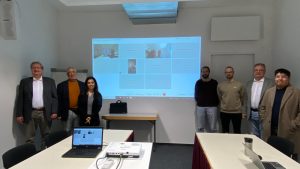
OPTI-6G Plenary Meeting: A Successful and Productive Gathering in Heidelberg
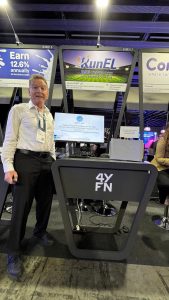
OPTI-6G Presence at Mobile World Congress 2025 trhough consortium partner RunEL
Overview
This project goal project is to design, develop and exhibit the operation of a Radio Optical 6G, so that it can easily be installed in a wide range of different types of properties and where third-party application developers can develop and exhibit their innovative network services in homes, businesses and public space buildings using the open-source development environment. Example services will be developed in the project such as one that ameliorates the need for using HeNB (Home Network Base Stations) or WLAN ( Wireless Local Area Networks) in buildings and eliminates the uplink interference that they induce. This will have the effect of incentivising all building construction companies to install a cell-free network throughout their new build developments. The OPTI-6G project will be the first project to integrate cell-free sub-THz and near IR 6G network architectures.
Project mission
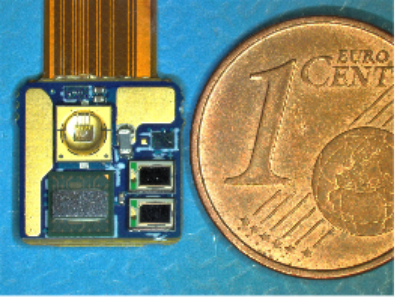 OPTI-6G project will significantly benefit 5G MNOs as it will considerably reduce EM interference that would have otherwise been generated by Home gNBs, thereby increasing throughput in the wider 5G mobile network and improving mobile access to users within buildings without incurring interference with the wider 5G mobile network and thus increasing the value of their customers’ buildings.
The net result is that there will be a considerable reduction of transmission power and EMF radiation levels, so the user equipment will potentially consume only one tenth of the energy, resulting in 90% energy savings, a tenfold increase in battery lifetime during use in buildings. This will be compared with a corresponding sub 6 GHz solution. The combined effects of a reduction in delay spread due to smaller room geometries, the adapted 3GPP 5G approach and the considerable reduction in propagation delays is expected to result in a reduction in latency to within 1 ms.