OPTI-6G project featuring the SNS JU Journal 2025
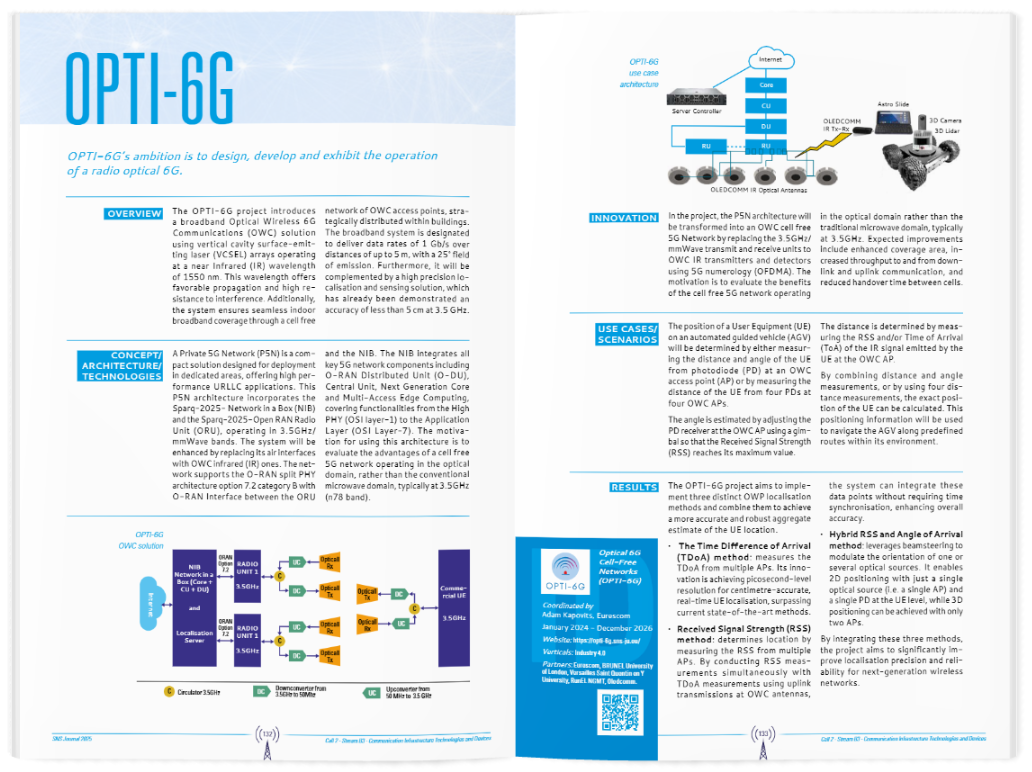
Europe’s Smart Networks and Services Joint Undertaking (SNS JU) is lighting the path to the next generation of wireless communications with OPTI-6G, an ambitious research project developing Optical Wireless Communications (OWC) for 6G networks.

  • 80 R&I projects
  • 1.8 M. Total funding 2021-2027
  • 500 M. EU funding allocated
The SNS JU Journal 2025 provides a comprehensive overview of the 79 research, innovation, and trial projects (out of 80) that form the core of the SNS JU’s portfolio. Backed by approximately €500 million in EU funding, these projects are pivotal to Europe’s goal of becoming a global leader in 6G technology, while also advancing the rollout of 5G. This portfolio reflects the strong commitment of European policymakers, industry stakeholders, and researchers to establishing a robust, competitive, and sustainable digital infrastructure.

OPTI-6G is part of the SNS JU Call 2 Projects: The 28 SNS Call 2 projects started in January 2024 or March 2024 in three streams or sub-streams and one CSA. The stream B covers research for revolutionary technology advancements, in preparation for 6G and revolutionary advancements for IoT, devices and software. The stream targets low to medium Technology Readiness Level in WP2023, to deliver innovative solutions towards real-life networks, in a long-term time period. It also includes targeted international cooperation with the USA, centred on Artificial Intelligence.


About OPTI-6G research

OPTI-6G’s ambition is to design, develop and exhibit the operation of a radio optical 6G. 

Using infrared laser technology at a wavelength of 1550 nm, OPTI-6G is building an indoor broadband system capable of delivering 1 Gb/s data rates over short distances—while offering exceptional resistance to interference. This cell-free optical network will also provide high-precision localisation with accuracy better than 5 cm, enabling advanced Industry 4.0 automation.

The project transforms traditional 5G architecture by replacing radio frequency links with optical transmitters and receivers, boosting coverage, throughput, and reducing handover delays. Three complementary positioning methods—Time Difference of Arrival, Received Signal Strength, and a hybrid RSS-Angle of Arrival—will combine to deliver reliable, centimetre-level location tracking for automated guided vehicles and industrial robotics.

Running from January 2024 to December 2026, OPTI-6G is coordinated by Eurescom with partners Brunel University London, Université de Versailles Saint-Quentin-en-Yvelines, RunEL NGMT, and Oledcomm. The project is part of SNS JU’s mission to secure Europe’s leadership in 6G research, innovation, and deployment.


More info page 132-133: https://smart-networks.europa.eu/sns-journal-2025/#sns-journal-2025-catalogue/134/

Recent Posts

Start typing and press Enter to search